Djembes and Fried Chicken

A friend in Chicago recently told me that there was a Scottish band by the name of Old Blind Dogs heading my way, and that they’d be at Caffe Lena soon. He advised we go, and asked we remember him to the band as the bouzouki player they jammed with in Flossmoor the day Bin Laden got knocked off. Ok, it was an introduction of sorts I suppose. The day had arrived, yet now I was losing my resolve to go. It seemed too expensive for us, plus I was rather pooped from my long day. I asked Elihu how he felt. I cited the pros and cons. I asked him on a 1 to 10 scale how he felt. He said 8. Then we pulled them up on you tube and listened. “Oh yeah, I wanna go” he said. “We gotta go, it’s a 10 now.” “It’s going to cost a lot” I warned, reminding him of our plans to build a new coop. “But I’ll always remember this!” He got me. That’s always been my ultimate gauge for making a decision. He was probably right. So I was off to clean up.

Caffe Lena is a tiny coffee house at the top of a creaky flight of stairs in Saratoga Springs which has been there over 50 years now. As a child I knew Lena, who was old by then, or at least to my young eyes looked as old and whiskered as a witch (I suppose everyone over 40 appeared this way). She was always kind to me when my parents would drop me off to hear a show. She’d wait at the top of the stairs and wave down to my folks, letting them know she’d keep watch over me. There’s a folk-art sort of portrait of Bob Dylan at the top of the stairs done on a piece of plywood, made on the occasion of his appearance there in 1960. The walls of the narrow downstairs hall are covered in ancient handbills of past performances under a thick, shiny lacquer. The bathrooms are tidy and their walls covered with happy graffiti. Elihu himself wrote in red sharpie on the night of his performance there last year. He had drawn a woodpecker climbing up the wall. Beside it he wrote “Elihu’s first open mic – 3/11/10” in a six-year old’s lettering. It was as much a right of passage for me as it was for him.

This time, Elihu counted the stairs as we creaked our way up towards the cozy room. I was ready to pay the steep admission, yet when they saw his size, the woman kindly offered to charge only $5 for his ticket. A nice way to start the night. Also, there were two unreserved seats right next to the drummer’s side of the stage. Wow. We’d gotten there early enough to find good seats, yet these were better than I’d hoped. It wasn’t a big place, yet Elihu can’t see much detail past ten feet, and so a table’s distance away can make a big difference in his experience. We were set!

The group’s bassist had been detained in Minneapolis by customs. I thought it a shame, both for the guy himself, and for the remaining trio. They’d have to fill it all up by themselves. I needn’t have worried. The three musicians created so much sound that the poor fellow was hardly missed. The drummer had a small setup; a large djembe sat before him, a deep snare to his left, then a high hat, a kick drum, another mounted djembe and two cymbals, one with a chain draped over it for sizzle. He also played a small talking drum which he could hold as he played. By mid-set Elihu was just not able to stop playing on the table. Even though our table partners seemed easy-going enough, I was worried that I might be the mom who thinks her kid’s so wonderful that rules don’t apply to him. “How bout just one finger? Like this.” I tapped with my index fingers on the edge of the table. Good solution, for a short while. Their energy was just too all-consuming. (At one point in a moment of inspiration he grabbed my arm and shouted in my ear “Mommy, I’m going to busk and make $25 and I’m going to buy myself a pair of brushes tomorrow!) The scene reminded me of years ago, when I’d go to shows with an egg shaker in my purse because sooner or later the music would become too compelling to resist, and I’d simply have to join in on something. Our neighbors were kind about it, but I was still unsure whether Elihu’s enthusiasm was too much. It was a great set, yet in spite of that Elihu was beginning to feel tired and he asked if we could go soon. I tried to distract him by calling his attention to something in the arrangement so that he’d forget about wanting to go; it was the first time I’d heard live music in such a long time and I wanted to stay. We made it to the end of the set, and the band announced they’d take a couple minutes’ break. Elihu and I made our way out.

The place is small, and the drummer was right there. Elihu stood before him and thanked him. “Do you want to see the drums?” the fellow asked. No doubt he’d noticed Elihu’s interest. The two walked back to his setup and had a little session. The drummer showed him his talking drum, and encouraged Elihu to try. He tried it briefly, but I could tell he was jonesin to get at the monster djembe on stage. “Go on” the man said, smiling kindly. Elihu ran the whole way round the room to get on the stage, and when he got there he sat down and began to play. It was a very loud drum, and he was playing a little rushed and scattered. I leaned in to encourage him. “Just do your groove, honey, you know, your thing“. He took a breath, then began.

Elihu grooved hard. He made a couple intentional false stops. He had the audience. He started up again. Not too long. Just enough. He slammed his hands down together in a final woomp. There. That’s it. The place went up in shouts and applause. During the whole thing I just laughed and laughed. Even though I know what he has, and how he’s gotten better, it felt just wonderful to have a whole room of people share in it together. What a moment. As we were leaving, the drummer gave Elihu a CD. I’d even considered buying one – something I’d seldom do – yet now here was another gift. Amazing. As I chatted my goodbyes to some folks at the ticket table, I noticed Elihu making small talk with the bagpiper – and the two parted laughing like old comrades. We smiled all the way down the stairs and onto the street.

A warm, weekend night in Saratoga is almost always a party. And so it was tonight. Before we’d gone to the show, we’d set an old dinner roll on the sidewalk outside to feed the sparrows with and found it still waiting for us. So we picked it up and headed around the corner into the alley in search of some birds. Hattie’s Chicken Shack was booming. People filled the restaurant. The old screen door creaked open and thwacked closed behind the crowds as they exited. We walked around to the back of the restaurant, hoping to find a late-night sparrow waiting for handouts, but it was too dark, too noisy, too Saratoga. There was a garden in the back of the place that was also full of people. The windows to the kitchen were open and faced the alley. “Look at all those guys workin so hard! They’re still slammed!” I said as I pointed to the chefs bent over stainless tables. One saw us and smiled. “Did you eat here tonight?” he asked. “Naw, a little pricey for us” I answered, smiling back. Truly, these days, it was a different Hattie’s. It wasn’t always so upscale; I could remember many decades ago when Hattie herself stood guard. Her ancient husband, a slight, bald black man was always in attendance, a towel draped over his arm. He was the epitome of gracious service. Many summer nights the restaurant was populated by only a few tables. The chicken was always the most delicious I’d ever had, anywhere. The cook shouted down to us from his window. “Want some chicken? Wait – just wait a second” he ducked back into the kitchen and returned with two drumsticks in his tongs, which he reached out the open window and handed to me. “They’re really hot, watch out”. I thanked him with a huge smile and a look of amazement. As I juggled the hot chicken, Elihu ran into a neighboring bar and came out with a pile of napkins. We made our way across the street to Ben & Jerry’s where they have large, freed-standing swinging seats for their patrons. Although it’s still a ‘new’ place in my mind, I realize that many local kids have grown up knowing this corner as if it’s always been here. My son will too. And so, it has become one of those defining little corners of the town. We sit to eat our chicken. We rock, we take in the perfect air. The sounds of bands come at us from distant bars. Bunches of big kids sit and check their phones. Couples walk by with their dogs. It’s a perfect night in town. We are in no hurry, and I wait for Elihu to have his fill. I don’t want to end tonight by telling him we have to go. We don’t.

But finally, it’s time. We get in the car, roll down the windows and begin to drive through the twinkling streets. We’ve brought along his djembe, and he plays it in the back seat as passersby look for the source of the sound. Soon we’re passing the mansions of North Broadway as we head out for the country roads. We put the CD in. It starts slow. “Where are the quarter notes?” Elihu asks. “There’s really no time yet, you can play what you like”. So he does. A freeform, expressive sort of playing. Then the groove begins. It fades up, and Elihu joins in. We are now winding through the dark on the last road to our house. The road twists and turns, it rises and dips. The music seems to grow with intensity as we come nearer to our home. Then we turn down the long driveway into the woods. When I bring the car to a stop, Elihu leans forward and gradually fades the track down to silence. We notice that Uncle Andrew has closed the chickens in their coop for us while we were out. It’s official, this night was perfect.
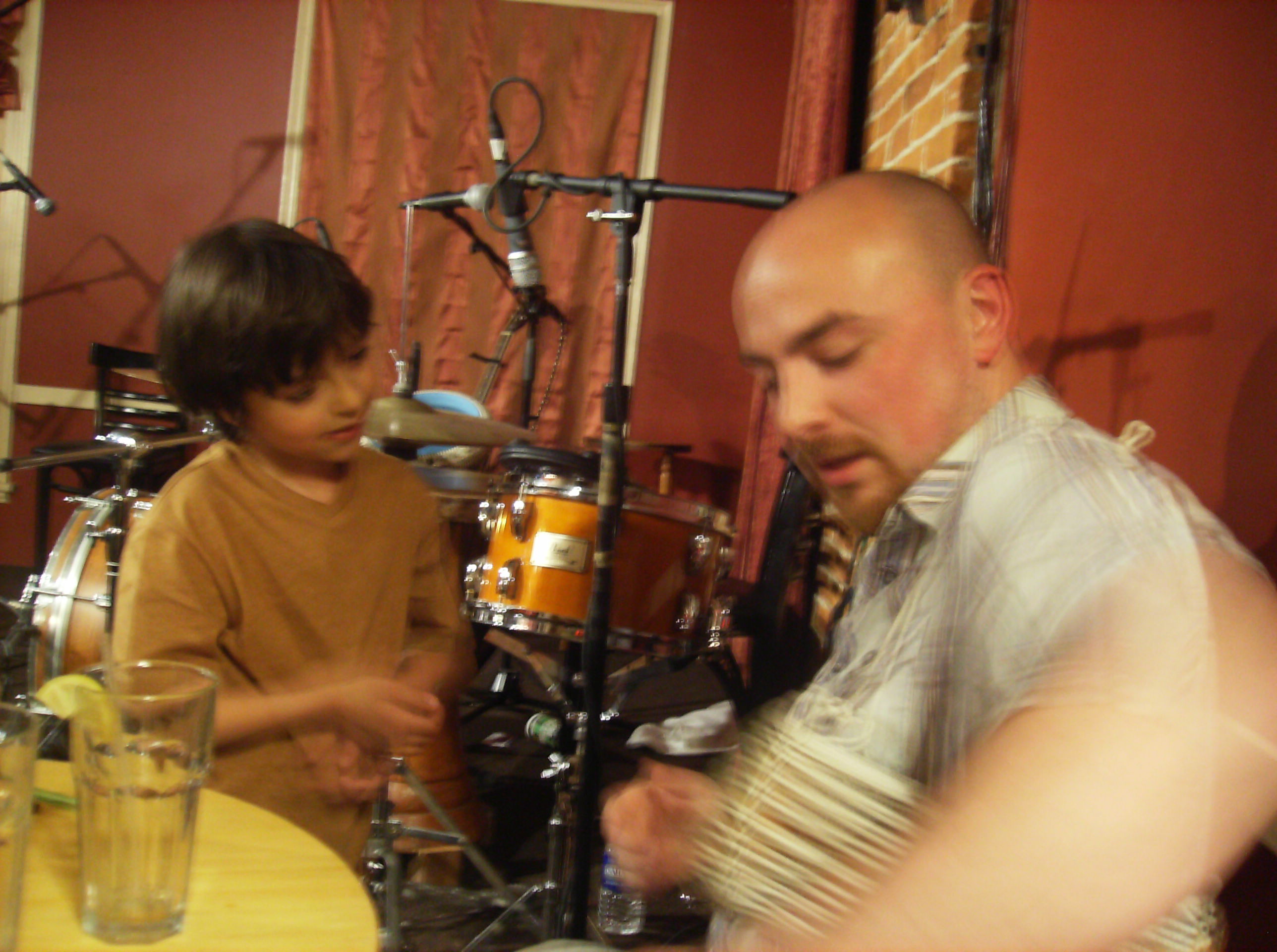
Elihu & Fraser of Old Blind Dogs at Caffe Lena


Famous Seamus

Few can actually say they are in possession of a dead parrot. This is our beloved and late parakeet, Seamus.

His death was sudden and rather dramatic (and also cost $118 for a final attempt at reviving him with some sort of injected medical cocktail) and I found myself sadder than I would have thought at his passing. As I stood in the vet’s reception area, holding Seamus, who was neatly resting on a teal blue towel in a perfectly sized box, my thoughts turned to Elihu. Just as the woman behind the desk was handing me the brochure on how to talk to your children about the death of a beloved family pet, he spoke up. “Can we have him taxidermed?” he asked, without registering much emotion on his face. I recalled a little sign I’d once seen for a taxidermist’s shop up by the Greenfield hills and replied “Yes, I know a place.” I paused to consider the logistics. “We can go there now if you like”. He jumped up and clapped his hands in joy. With a disappointing audience of the somewhat humorless lady behind the counter, I threw the pamphlet over my shoulder in a ‘I give up’ sort of gesture, and we headed out the door with our ex-parrot in a box.

Note: Neither the mention of an ‘ex-parrot’ nor ‘how to put your budgie down’ is lost on my dearest Elihu. How much fun it is to have a child with that sort of twinkle in his eye, and that kind of material in his repertoire.

Famous Seamus the Taxidermed Parakeet

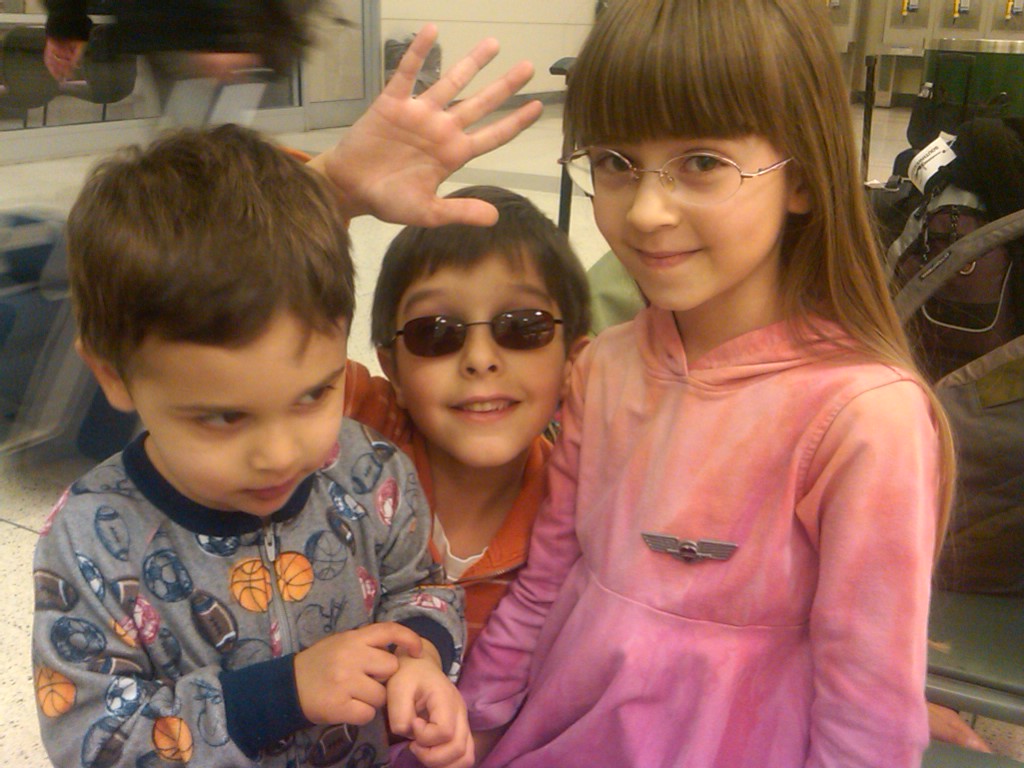
3 Kids. 3 Moms. 1 Dad.

3 kids of F
three kids, three moms, one dad.

left to right: Charlie (of Jill), Elihu (of me), Brigitta (of Cindy)

I’m sure this won’t hurt me as much in twenty years as it does now. It’s still hard to know that Cindy and I were pregnant at the same time with our children. Strange. It will be interesting to know these children as adults and learn how life felt from their perspectives.

Snowflakes

It’s a snowy December night in a tiny, rural Midwestern town. We are at the town’s recreation center, a building that looks rather like a four car garage. The grounds are a few open acres with a playground at the far end. Beyond the chain link fence an ocean of cornfields extends for miles out into the blackness. Big, sparkly clusters of snowflakes are falling. They seem to appear from out of nowhere when they hit the parking lot lights. A narrow gauge train idles near the sidewalk waiting for the next load of passengers, which will be shuttled along a great oval track around the park. The train will pass homemade displays of lights setup across the lawn, the ride culminating in its passage through a tunnel of lit Christmas trees near the loop’s completion. It’s a nice crowd – enough families to be lively, yet nowhere close to crowded. A good place to be at this holiday time of year.

Our four-year-old son wants to see the train up close. Already marching to the beat of a very different drummer, he wants to know if the little train has a diesel engine, and he wants to see so for himself. Currently, he is a train boy. A little bit of Thomas the tank engine, yes, but mostly he lives on a constant stream of information about the history and evolution of the train. His book collection is mostly limited to encyclopedic volumes on the subject. He has learned how to instantly multiply by two, motivated by the need to know the type of train as described by its wheel profile. He knows his ponies from his drivers. This is the place to be at Christmastime for just such a young boy.

I hold his father’s hand and our son walks ahead of us to the train. We are walking slowly. It is one of those magical winter nights. As I look upwards towards the falling flakes I feel as if I’m flying forward through space at a great speed. The snow is so perfect it hardly looks real. I look at my husband with a question on my face. He squeezes my hand reassuringly, and then winks both his eyes – he isn’t able to wink just one at a time – and he nods just a bit, with a half smile. “Nothing will change,” he says. “You’ll see. It will always be like this”. Really? I think. I wonder if I heard correctly. I feel like I’m drugged anyway. I’m not sure what’s real right now. Did he just say it will always be like this? How could it be? I wonder. Then I ask him this aloud, but my voice is soft, and it sounds like I’m talking to myself. I am in a daze. I can’t decide whether the setting takes the edge off, or if it just adds to the surreal quality of my life tonight.

Just a few weeks earlier my middle-aged husband told me he had a young girlfriend in our new community, and that he had decided he was going to make his new life with her. The words he used sounded sickly chauvinistic in this strange new context: “she’s carrying my baby” he’d said to me. They’d been through a lot together he explained; she’d been pregnant by him once before, but she’d chosen to have an abortion. They’d been on again and off again for the past two years, struggling in their lover’s dilemma. He’d thought I’d known about her.

I hadn’t.

The past three weeks since he’d told me, he’d seemed much lighter. He had been increasingly distant and less like his old self of the past couple of years. Although I wasn’t the recipient of his affection any more, at least I benefited from his lighter mood recently. He had unburdened himself. He was finally free. But my incarceration was just beginning.

Just two years earlier, I’d been in our beloved Evanston home just outside of Chicago, making tea for my husband and father-in-law who sat on the couch, and who had begun to make their pitch about my husband and me buying a business. They were proposing we buy a building in the town in which my husband taught part time, in a town 75 miles from our home. The building even came with a restaurant – one which we could own and run ourselves. At first I was puzzled; we were musicians, what did we know about running a restaurant? I paused for a moment to understand them better – wait, were they actually serious about all of this? Yes. It turned out they were.

My husband was convinced that with the current team of employees, the place would easily run itself; we didn’t even need to be there! It just didn’t sound realistic to me, and I wasn’t on board. I’d worked plenty of waitress jobs, and I knew that running a restaurant was so much more than a full time job. I also knew that absentee owners were completely at the mercy of the staff. When the cats were away, the mice were definitely hosting after hours parties.

But the pitch continued for weeks, months. It was a sure thing. A sound thing. A dependable source of income. We went to inspect the place and then pour over the pages of numbers the previous owner provided for us. (I’ve since learned about the malleability of numbers; they can be arranged as creatively as a piece of music.) Finally, we were going to own a real, money-making commercial property just like his parents. We would be real grown ups now.

The restaurant was in a small college town that was an hour and a half’s drive away from our current home; it was the town in which my husband taught three days a week at a state University. The weekly commute he made was becoming too much for him – and also too much for all three of us. Although we weren’t entirely decided, we had begun the discussion about moving. If we were going to have a second child, it really did seem to make sense. My husband made the point that until we made the decision whether to move or not, he was out there every week anyway – he would be there to make sure things ran smoothly.

Even though I was never completely convinced it was a great idea, I really did want to support my husband in his vision; is that not what your partner is for? Yet I found myself wondering if it really was his vision – or his father’s. In the end it didn’t matter; whether he was driven to acquire the property to impress his father or to satisfy his own ambition, it was becoming very important to him. He was fired up to do this, and he needed me on board. So I agreed. We went ahead and bought the building, and the business too.

For a year it seemed to go all right. My heart was still tied to the community in which I’d lived my entire personal and professional life – where we continued to live – and I wasn’t keen on moving. I was now mother to a young child with low vision issues who needed my help physically navigating about his world. I had experienced the sorrow and loneliness of a miscarriage that year too. My husband had been out of the country on the day I miscarried. He was on the road a lot. He later confessed he “knew it was over” when I miscarried.

Wait, what? A two-decade union is just “over” when the wife miscarries?

It seemed to me that this should have been a time for solidarity, love and compassion, a coming together and a re-dedication to create the family that was yet to be…  I’d kinda thought that was where we would find ourselves. But instead, no discussion was had, and I just assumed we were on the same page. The marriage went on for two more years during which he never brought up the subject. I had no idea that he’d considered us “over” from that first miscarriage. Hope pulled me forward. Our family would join us soon; our someday couldn’t be too far off. After all, we made no efforts to prevent a new soul from joining us…

When my husband wasn’t teaching, he was touring. I was on hold, waiting. Just waiting. My husband didn’t talk about looking for a house anymore. When we spoke, he talked only of the business. Things I couldn’t really help him with. I spent most of my time at home, he spent most of his time away. Within months the darkness began.

The restaurant manager in whom my husband had put his trust was ruining us. Whether she was stealing, making bad choices – or both – it didn’t matter. Here was the alarm call. What seemed like a far-off reality became my immediate to-do list. Clean, pack, list old home, find new home. Within months I was standing in the living room of our new house, surrounded by boxes, two cats and a small child. Starting over.

The next year was a whirlwind. I had to step in and run a business, I had to use whatever knowledge my previous supplemental part time jobs had taught me. I had to order food, create menus, set prices, paint walls, unclog toilets, renew liquor licenses, pass health inspections, tally time cards, hire bands, fire employees, make peace with the police, meet with the mayor, settle disputes. It was baptism by fire, and nothing I’d bargained for. My Pakistani father in law kept telling me we should just sell homemade pakoras and that would save the business. My husband told me it was not as hard as I made it seem. “I ran this from a cell phone for a year!” he would scold. And so I muscled on. In one year I experienced events that I would have expected from a decade.

Between the duties of café owner and mother I fairly passed out at the end of each grueling day. I’d noticed my husband taking on a strangely quiet distance – and our sex life was currently non-existent – but as the business was hemorrhaging money I thought it was the obvious reason for the changes in him. There was a pit of fear in my stomach nearly every day of that year. Just getting out of bed in the morning took a huge effort of will. I’d figured my husband, my partner of more than two decades, was feeling the stress too, and this was his way of riding out the tough time.

After two years we finally decided the grand experiment was over. I had a good plan. I also had a good manager. She wanted in, and I wanted out. We passed the café on to her. Now we would simply collect rent on the space. When she signed the lease, I felt the most supreme relief I’d felt in years. In spite of a two year detour, we were now poised for our new life to begin. A new life to be sure. Not one I ever could have seen on the horizon.

We wrapped up the business. Then a few weeks later, we wrapped up our marriage.

Fareed had a pregnant girlfriend, and that was that. He’d been increasingly distant over the past two years, and now, at the very least, I had finally learned why. It’s one of the worst kinds of things to hear said aloud. So painful, so strange. So unreal. So surreal.

It is now almost three years later. I live on ten acres in rural upstate New York, just outside an historic, cosmopolitan college town. I live two doors over from my aging parents with our son, who is now 7. I am now 47, and have finally come to terms with the reality that I will no longer bear another child. My husband now has two young boys with his girlfriend. The juxtaposition of her youthful, childbearing chapter and my peri-menopausal reality can weigh heavy on my heart if I think too long about it.

As with any experience in life, it’s often not until the event is well in your past that you can fully glean the insight it offers. For as much sorrow as I have felt over not having our second child, I can say now that I am glad not to be parenting two young children by myself. For I surely would have been, if I hadn’t miscarried. The relationship I have with my son would be entirely different if he had a sibling who also needed me. I simply would not be able to devote myself as fully to two children as I can to one.

I want to be truthful about our new life. Sometimes it is downright lonely. Sometimes it really hurts. The poverty we now live with can add to the sense of betrayal, especially when we’re weakened with grief. There are moments when my son weeps inconsolably that we two live alone, that he lives without siblings, without a dad, without the noise of a full house… There are moments when I too can do no more than drop my face in my hands and sob, for me, for my son…. My heart just breaks that my son will never have a father here in our home; a father to help with homework, to sit at the supper table, to wrestle with on the living room floor… I am, however, grateful that he’ll always have his father in his life. His dad visits every month or so, and our son goes back to the midwest too. When he visits his father, our son stays in our old house, in his own bedroom. He does have a father, and a father who loves him dearly. He’s ahead of many.

Although I would never have chosen any of these experiences for myself, life has given me a surprising reward in exchange. I have a relationship with my son that is so intimate, honest and strong, that I absolutely know I got a good deal – even with the betrayal and sorrow. My son and I are living a life rich in nature, music, art, self-discovery and love. A life very different from the one we might have had. I could never have envisioned our life as it is now. Everything about our new life was a total surprise; our new life simply came from out of nowhere.

In spite of the hardship, the last few years have presented me with so many opportunities. Even in the midst of my pain, I was always aware that there were lessons here somewhere that I needed to learn. Things I needed to pay attention to, to resolve. But despite my own self-coaching, learning still just isn’t as easy as it seems it should be. Sometimes, when I think I’ve got my head wrapped around this, and I’m praying for forgiveness to live in my heart – just when answers should be a moot point – questions still pop into my mind. And I often think of that snowy night at the Christmas train ride…

What did my husband mean when he said nothing would change (while holding my hand)? Everything changed! Oh how many times I’ve wondered just what exactly was he was thinking when he said those things to me! Did he mean them, or were they just words to soften the sting? Or might he have truly believed them?

When the questions and the ‘what ifs’ arise, I make an effort to send them on their way as quickly as possible. These past few years I’ve seen what a waste of energy it is to consider the things that might have happened. This happened. It’s my reality. I start from here. There is no other option.

People see the same things so very differently. What was my former husband experiencing that night?  I don’t know. What choices was he planning on making? No idea. I can only know my own experience, and I can only know the choices I make for myself.

And so, I will choose to remember the beautiful snowflakes that appeared from out of nowhere.